Home Systems
Cladding chosen for ember exposure, UV, and a 40°F daily swing.
Most of the Hill Country is wildland-urban interface. Your exterior wall is either an ember-resistant assembly or a fuel source, and the details that decide which one — soffit, vent, and the first six feet of wall — are where cheap siding jobs cut corners.
WUIWildland-urban interface
5 ftNoncombustible zone at grade
1/8"Maximum vent mesh opening
40°FDaily thermal movement
What is the best siding for a wildfire-prone Hill Country property?
Fiber cement or noncombustible masonry, detailed for ember resistance. In a wildland-urban interface, most homes ignite from wind-blown embers rather than a flame front — and embers collect in soffit vents, at the wall-to-deck junction, and in the first few feet above grade. The practical specification is a noncombustible cladding, 1/8-inch or finer metal mesh on every vent, closed or fire-resistant soffits, and no combustible material or mulch within five feet of the wall.
Ember resistance is a detailing problem
The image most people have of wildfire loss is a wall of flame consuming a house. The documented reality in interface fires is far more mundane: embers travel ahead of the fire, land in an accumulation point, smolder, and ignite the structure hours later, often from underneath or behind.
That means the material choice is necessary but not sufficient. The vents are the failure point. Standard soffit and gable vents pass embers straight into your attic. Screening every vent with 1/8-inch or finer corrosion-resistant metal mesh is inexpensive and is one of the highest-value retrofits available on a rural property.
The other accumulation points: the junction where a wood deck meets the wall, the first five feet above grade where mulch and vegetation sit, and open eaves. We detail all of them as part of a siding scope rather than treating siding as a purely cosmetic replacement.
UV, thermal movement, and hail
Setting fire aside, Hill Country exposure is punishing on cladding. Triple-digit UV fades and chalks organic finishes fast. A 40°F daily swing cycles every joint and fastener year-round. And hail that dents metal will crack brittle claddings and puncture vinyl.
Fiber cement handles all three well — dimensionally stable, noncombustible, and it holds a factory finish for a long time. It is heavier and less forgiving of sloppy installation than vinyl, which is exactly why installation quality is where we spend the attention: correct fastener placement, gapping and flashing at every butt joint, kickout flashing where a roof meets a wall, and a continuous water-resistive barrier behind the cladding.
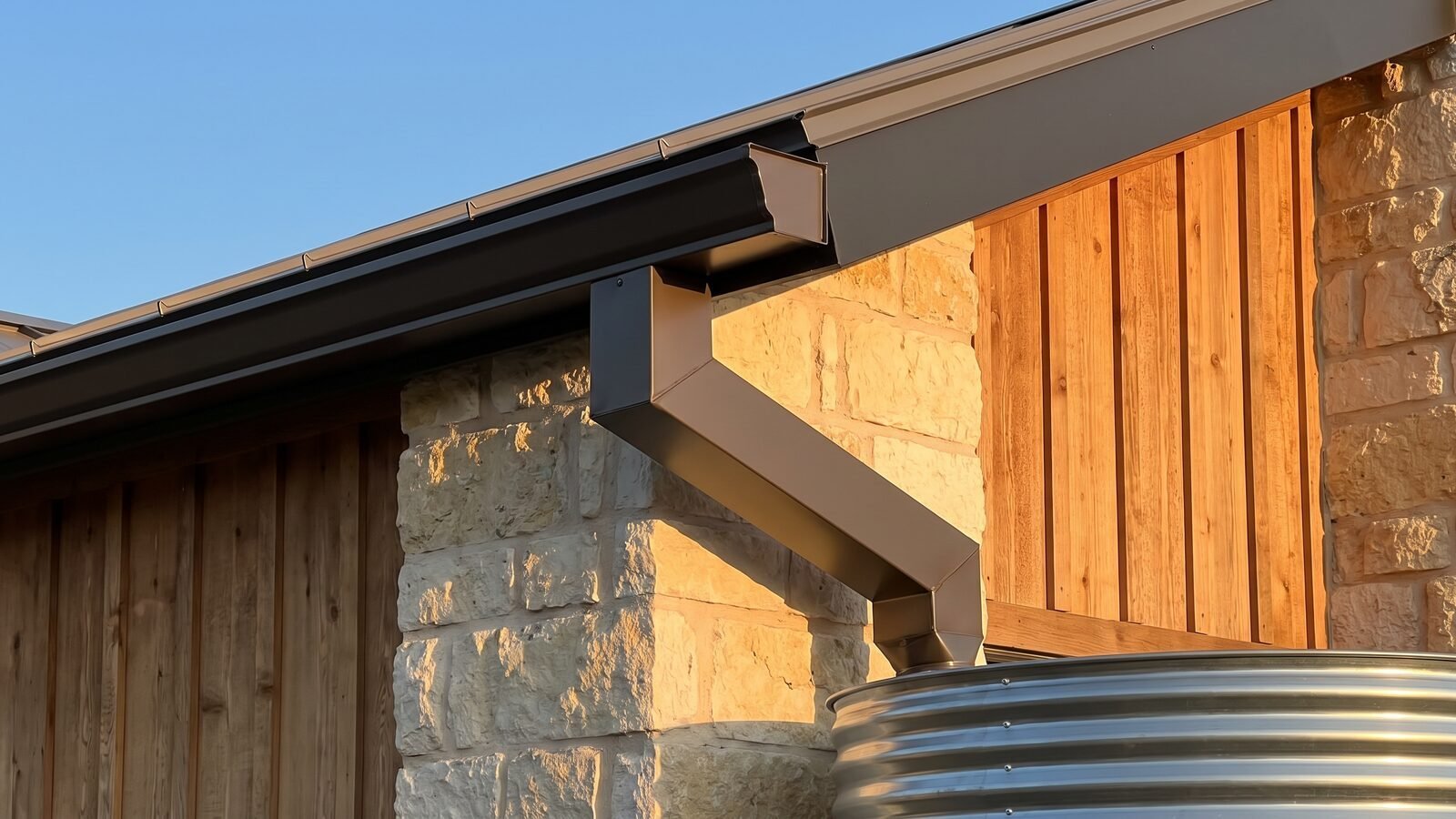
That kickout flashing detail deserves a specific mention: where a roof edge terminates against a wall, water without a kickout runs behind the siding instead of into the gutter. It is a small piece of metal and it is the source of a large share of the hidden wall rot we open up.
Specification
| Item | What we install |
|---|---|
| Cladding | Fiber cement lap or panel, factory-finished |
| Barrier | Continuous water-resistive barrier, taped and lapped |
| Vents | 1/8" or finer corrosion-resistant metal mesh on all vents |
| Soffits | Closed or fire-resistant assembly at eaves |
| Flashing | Kickout flashing at every roof-to-wall termination |
| At grade | Noncombustible first five feet; no mulch against the wall |
| Joints | Gapped, flashed, and sealed for thermal movement |
Talk about your siding & exteriors project
Tell us the property and the scope. We start with site and systems discovery, not a sales pitch.
Bid comparison
Where the cheap bid is actually cheaper.
Two proposals for the same job usually differ on these lines, not on brand. Ask any bidder to put their answer in writing.
| Common low-bid approach | The A1 specification |
|---|---|
| Vinyl over the existing wall | Barrier inspection, rot repair, fiber cement |
| Unscreened soffit and gable vents | 1/8" metal mesh on every opening |
| No kickout flashing | Kickout at every roof-to-wall junction |
| Caulk-only butt joints | Gapped and flashed for movement |
Siding & Exteriors questions
Answered plainly.
Is fiber cement worth the premium over vinyl here?
In a wildfire-exposed, hail-prone, high-UV climate, yes. Vinyl is combustible, it deforms at temperatures a nearby grass fire easily produces, and hail punctures it. Fiber cement is noncombustible, dimensionally stable through 40°F swings, and holds a factory finish for far longer.
What is the single cheapest thing I can do for wildfire resistance?
Screen every vent with 1/8-inch or finer metal mesh, and clear combustible material out of the first five feet around the house. Embers entering an unscreened attic vent is the most common ignition path in interface fires, and both fixes cost very little relative to the risk they remove.
Can you do siding and roof in one mobilization?
Yes, and it is the right sequence. Roof-to-wall flashing, kickout details, and the top course of siding all interact. Doing them as one scope with one crew removes the seam where two contractors blame each other for a leak.
Also in Home Systems
Related scopes.