Why a house on rock still moves
Homeowners here reasonably assume that limestone bedrock means a stable foundation. Then a door starts dragging in August, and a hairline crack walks up the drywall above a window.
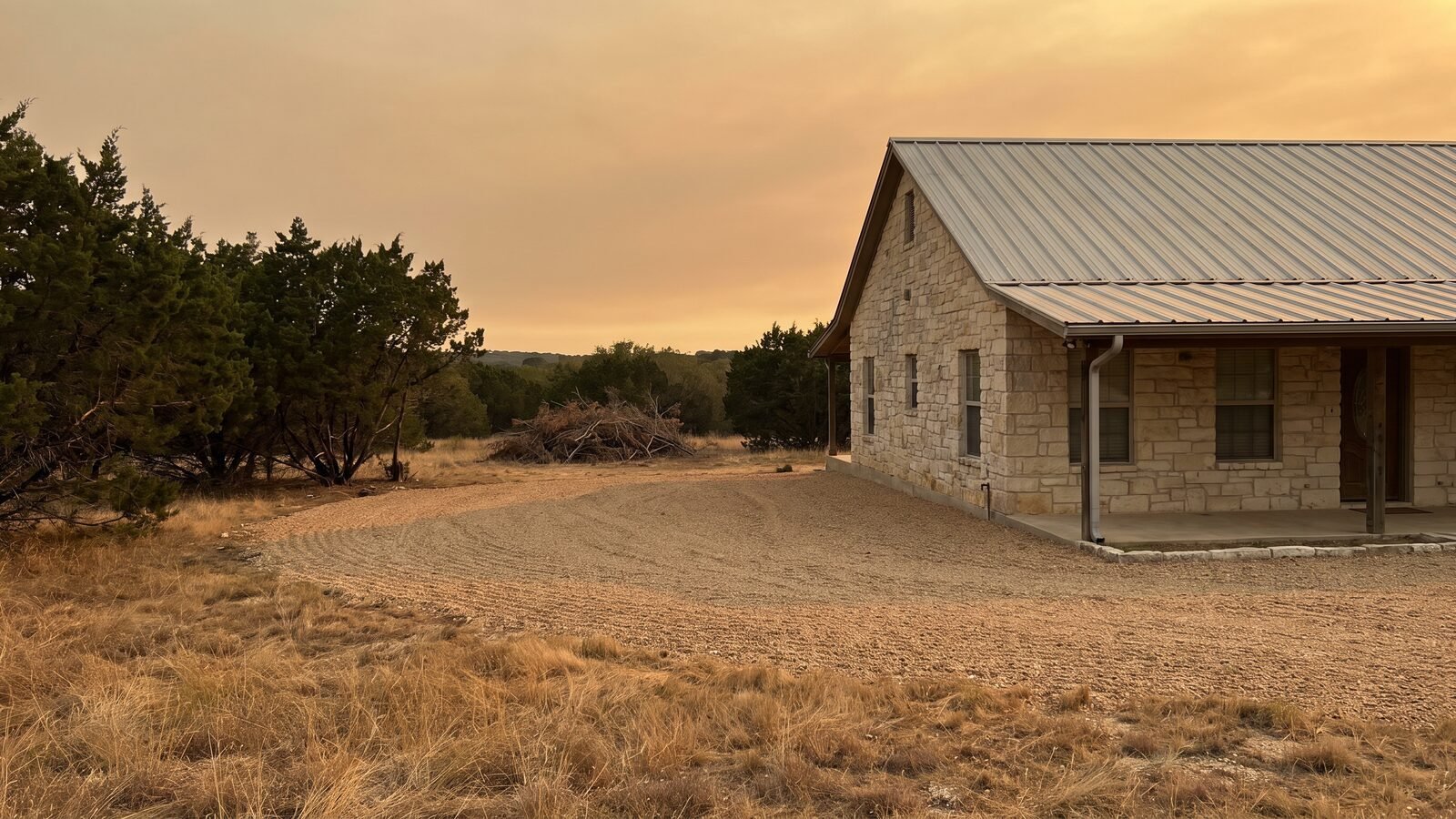
The explanation is what sits on top of the rock. Across most of the Hill Country, the limestone is capped by a mantle of clay-rich soil — sometimes several feet of it, sometimes a foot, and rarely uniform across a single lot. Builders cut and fill to make a level pad, which means the soil profile under one corner of your slab may be nothing like the profile under the opposite corner.
That clay is expansive. Its clay minerals absorb water into their crystal structure and the soil volume physically increases. Dry it out and the volume decreases, opening shrinkage cracks you can sometimes drop a tape measure into. Your slab is riding on that.
The mechanism: shrink-swell and differential movement
A slab does not care about being high or low. It cares about being twisted. Uniform movement — the whole house rising an eighth of an inch in a wet spring and settling back in the fall — does essentially no damage. Damage comes from differential movement: one region of soil changing volume while an adjacent region does not.
That is why the classic Hill Country damage pattern is so consistent. Cracks radiate from door and window corners, because openings are where a rigid wall is weakest in shear. Doors bind at the top on one side. Tile grout cracks in a straight line across a room. Exterior brick or stone shows a stair-step crack following the mortar joints.
And the geometry of a house guarantees uneven drying. The perimeter dries fastest — sun, wind, and evaporation all work the edges. The soil under the center of your slab is shielded and holds moisture far longer. A long August drought shrinks the perimeter soil while the center stays supported, and the slab edges settle. This is called edge drop, and it is the most common movement mode in this region.
Add the localized effects, and the picture is a slab under uneven load from several directions at once:
- A downspout dumping several hundred gallons at one corner keeps that spot swollen year-round
- A large live oak or elm on the south side pulls hundreds of gallons a week out of the soil in summer
- A driveway or patio slab acts as a moisture cap, holding water under one edge and not the others
- An air conditioner condensate line discharging at the wall creates a permanently wet zone
- Cut-and-fill grading means the native soil depth genuinely varies from corner to corner
How to read your own house
Before you install anything, spend twenty minutes documenting. This costs nothing and it is what turns "I think it is getting worse" into information an engineer can use.
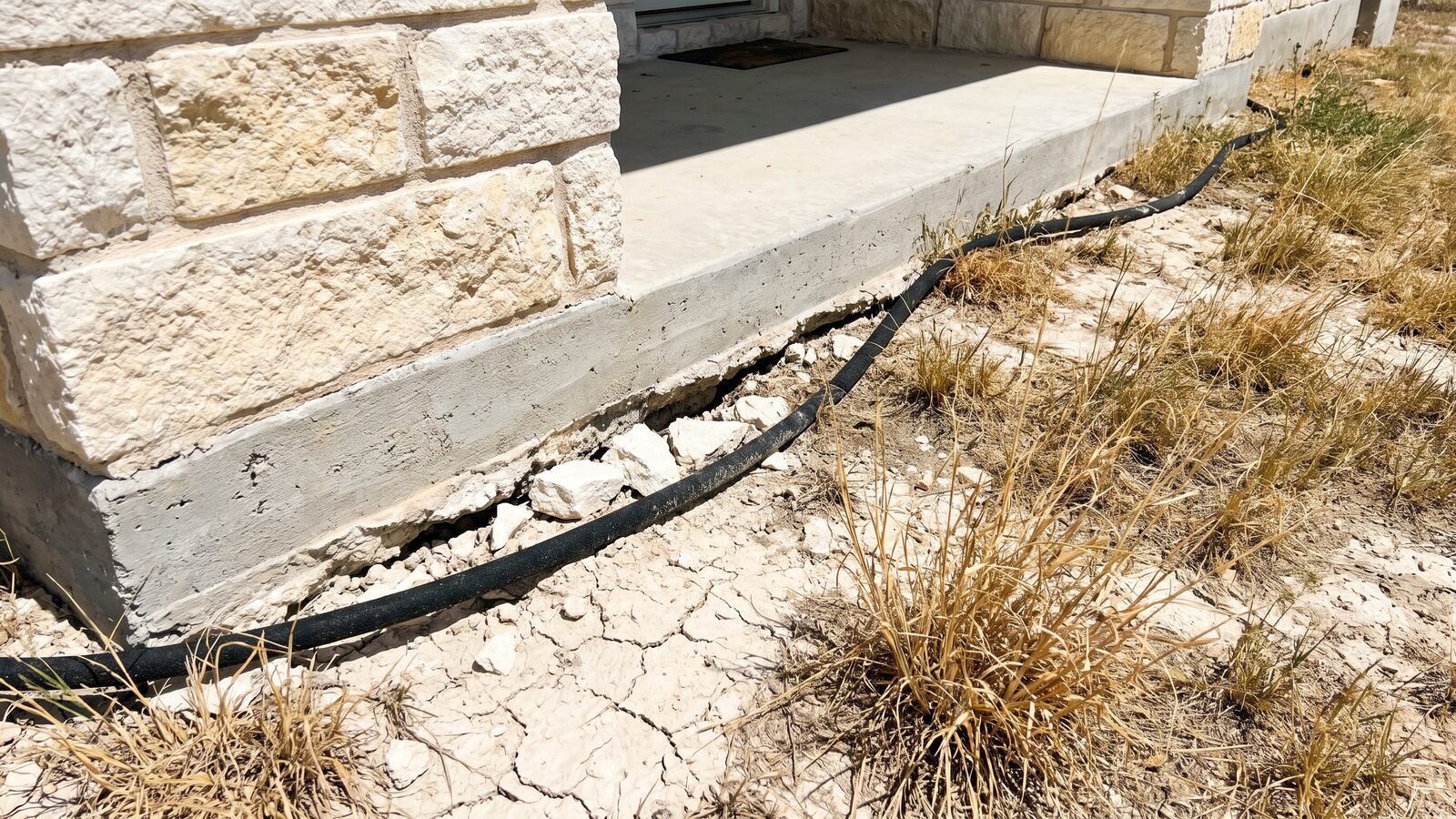
Walk the perimeter after a long dry spell. Look for a visible gap between the soil and the slab edge, and for shrinkage cracks in the yard — those tell you your soil is genuinely expansive and how much it is currently shrinking. Then walk it after a heavy rain and note anywhere water stands or where soil is visibly saturated against the wall.
Inside, photograph every crack with a ruler or a coin in frame, and write the date on the photo. Mark the end of a crack with a light pencil tick. A crack that has not moved in two years is a historical record; a crack that grows a quarter inch across one summer is an active problem. Without dated photos, nobody can tell you which one you have.
| What you see | What it usually means | Urgency |
|---|---|---|
| Hairline cracks at door and window corners, stable over years | Normal seasonal movement, already settled in | Monitor |
| Doors binding at the top in late summer, freeing up in winter | Seasonal shrink-swell cycling at the perimeter | Address moisture |
| Diagonal cracks widening measurably over one season | Active differential movement | Get an engineer |
| Stair-step cracking in exterior masonry mortar | Foundation movement transmitted to the veneer | Get an engineer |
| Gap opening between the soil and the slab edge in drought | Perimeter soil shrinking away — classic edge drop | Start watering |
| Standing water against the wall after every rain | Grading or drainage defect — fix before watering | Fix drainage first |
A watering schedule that actually works
The objective is stability, not saturation. You are trying to hold the perimeter soil at roughly the moisture content it has in a normal spring, all year, so the clay never goes through a large volume change.
Use soaker hose, not sprinklers. Sprinklers wet the surface, evaporate, and never reach the depth where the clay is actually shrinking. Lay the hose 12 to 18 inches out from the slab, not right against it — you want to moisten the soil that supports the edge, not to funnel water down the outside face of the foundation. Run a continuous loop around the entire perimeter, or move one length methodically, but treat every side the same.
Frequency beats duration. Twenty to thirty minutes every second or third day during a dry spell does far more good than two hours once a week, because you are maintaining a level rather than swinging between extremes.
The rules that matter most:
- Stop when it rains. Overwatering causes heave, which is just as damaging as shrinkage. A cheap rain gauge is the whole instrument set you need.
- Never soak one side only. Treating the visibly cracked corner and ignoring the rest is how you manufacture differential movement.
- Start before the drought, not during it. Rewetting deeply shrunken clay is slow, uneven, and can itself cause movement. Begin as soon as the soil starts pulling back.
- Keep it up in winter. Hill Country winters are frequently dry. Reduce frequency, do not stop.
- Fix drainage before adding water. If water already stands against the wall after rain, watering adds to an existing problem.
The trees question
A mature live oak can move hundreds of gallons of water a week during a Texas summer, and its root system extends well beyond the canopy. A large tree close to the house is the single most powerful moisture influence on your foundation — usually stronger than anything you do with a hose.
This is not an argument for cutting down your oaks. They shade the house, they are frequently protected by local ordinance, and removing a large tree can trigger its own problem: the soil that the tree kept dry for decades slowly rewets and heaves. Removal has to be considered as carefully as retention.
The workable answer is usually to water the zone between the tree and the house more attentively than the rest of the perimeter, so the tree draws from soil you are replenishing rather than from soil supporting the slab. Where a tree is very close and damage is active, a root barrier installed by a company that does that specific work is the standard mitigation — but that is an engineer-and-arborist decision, not a DIY project.
What gutters have to do with your foundation
This is where roofing and foundations turn out to be the same subject, and it is the reason a roofing company is writing this guide.
One inch of rain on a 1,000 square foot roof is roughly 600 gallons of water. Without gutters, that volume does not disperse — it falls in a concentrated line along the drip edge and soaks a narrow trench right at the foundation. A house with no gutters has a permanently over-wet perimeter strip in the wet season and a shrinking one in drought, which is the exact cycle you are trying to eliminate.
With gutters but short downspouts, you have made it worse in a different way: instead of a line load, you now have four to eight concentrated point loads dumping hundreds of gallons at specific corners. That is a recipe for differential movement.
Discharge at least 10 feet from the foundation, farther if the grade slopes back toward the house. Where surface grade will not cooperate, run buried solid PVC to a daylight point or a dry well. And check that the soil grade itself falls away from the slab about six inches over the first ten feet — no amount of gutter work fixes a negative grade.
When to call an engineer instead of a contractor
Moisture management is homeowner maintenance. Diagnosis is not. If you are seeing measurable, progressive movement, the right first call is a licensed professional engineer who does residential foundation evaluation — not a foundation repair company offering a free inspection.
The reason is structural: an engineer sells you an opinion and a floor-elevation survey, while a repair company sells piers. Both may be honest, but only one is paid the same whether or not you need work. An engineer's report gives you a documented elevation baseline, a cause, and a specific recommendation, and it is what you want in hand before authorizing any underpinning.
Signs that it is time: doors or windows that no longer close at all, cracks wider than about a quarter inch, cracks that visibly lengthen within a single season, separation at the ceiling-wall joint, or a floor with a slope you can feel walking across it.
Frequently asked
How long should I run a soaker hose around my foundation?
Roughly 20–30 minutes every second or third day during dry weather, on all sides equally, with the hose 12–18 inches out from the slab. Stop when it rains. Frequency matters more than duration — you are holding moisture steady, not saturating the soil.
Can I overwater my foundation?
Yes, and it causes heave, which damages a slab just as effectively as shrinkage. Expansive clay swells when it takes on water. If water stands against the wall or the soil stays soggy between waterings, you are overdoing it. A rain gauge and a habit of shutting off after rain solve this.
Do I need foundation watering if my house is on a pier and beam?
Less critically, but the piers still bear on the same expansive soil, and uneven moisture still moves them. Pier and beam is more forgiving because the structure can flex, and crawlspace ventilation and drainage become the more important concerns.
Is a crack in my slab or drywall an emergency?
Almost never on its own. Hairline cracks at door and window corners that have been stable for years are typically settled seasonal movement. What warrants a professional evaluation is measurable progression — a crack that grows across one season, doors that stop closing entirely, or a floor slope you can feel.
Will gutters alone fix my foundation problem?
They will remove one of the largest and most correctable moisture variables, which is often enough to stop progression. They will not reverse movement that has already occurred, and they cannot compensate for a negative grade or a large tree drawing water from under the slab.
This guide is general regional information for Hill Country property owners, not engineering, medical, legal, or insurance advice for your specific property. Figures cited reflect commonly published agency, manufacturer, and industry sources and vary by site. For foundation movement consult a licensed professional engineer; for water quality use an accredited laboratory; for wildfire mitigation see Texas A&M Forest Service guidance and your local fire authority.