Nobody is testing your water but you
If you moved from a city to a place like Dripping Springs Estates, this is the most important adjustment to internalize. A municipal utility tests continuously, publishes an annual report, and is legally required to notify you of a violation.
A private well in Texas has none of that. There is no routine testing requirement, no agency monitoring your water, and no one who will tell you something has changed. Construction standards apply to drilling and to plugging, and the driller files a log — but ongoing water quality is entirely the owner's responsibility.
The practical consequence is that contamination is usually invisible. Coliform bacteria and nitrate produce no taste, smell, or cloudiness. Families drink unsafe water for years without any sensory clue, and the highest-risk group — infants, for whom nitrate is genuinely dangerous — cannot tell you anything is wrong.
Why karst limestone changes the risk
The Hill Country sits on karst: limestone that water has dissolved into fractures, conduits, sinkholes, and caves. It is why the region has springs, and it is why groundwater here behaves differently from groundwater in a sand aquifer.
In a granular aquifer, surface water percolates slowly through sand and soil, and that slow passage filters out pathogens over weeks or months. In karst, water can move through open fractures and conduits at speeds measured in hours to days, with very little filtration. Dye-trace studies in the Edwards system have repeatedly shown rapid, long-distance connections between surface features and wells and springs.
The takeaways are concrete. A contamination source can be far from your well and still reach it. Bacterial counts can spike sharply after heavy rain, because the rain flushes surface material into recharge features. Testing right after a major rain event tells you something a dry-season test cannot — and a clean test in August does not certify your water in a wet May.
This is also why the Edwards Aquifer recharge and contributing zones carry additional regulatory review for construction, and why what your neighbors do with their septic systems is genuinely your business.
What to test for, and how often
Use an accredited laboratory, not a hardware-store strip kit — strips are useful for tracking hardness, and not for anything health-related. County extension offices and Texas certified labs provide sample bottles with instructions; follow the collection procedure exactly, because a mishandled sample produces a false positive that costs you a chlorination you did not need.
| Test | Frequency | Why it matters here |
|---|---|---|
| Total coliform & E. coli | Annually, plus after any flood or well work | The core safety test. Indicates a pathway from the surface into your well. |
| Nitrate | Annually if septic, livestock, or ag is nearby | Dangerous to infants under six months. Odorless and tasteless. |
| pH and total dissolved solids | Every 3–5 years | Corrosion and scaling behavior; affects plumbing and appliances. |
| Hardness | Once, then when treatment changes | Sets softener sizing. Typically 15–25 grains per gallon here. |
| Metals panel (arsenic, lead, iron, manganese) | Every 3–5 years | Regional geology and older plumbing components. |
| Anything unusual in taste, smell, or color | Immediately | A change is information; do not wait for the annual test. |
Reading your own results
Total coliform present. Coliform bacteria are common in soil and surface water and are mostly not harmful themselves. Their presence means there is a route from the surface into your well — a cracked casing, a bad seal, a submerged wellhead, or a nearby recharge feature. Shock-chlorinate, find and fix the pathway, then retest. Repeated positives after chlorination point at a construction defect, not a one-off.
E. coli present. This is fecal contamination and it is not a wait-and-see result. Stop drinking the water immediately, use bottled or boiled water, and get a licensed well contractor out. Septic proximity or failure and livestock runoff are the usual sources.
Nitrate above 10 mg/L. This exceeds the drinking water standard and is specifically hazardous to infants under six months, in whom it causes methemoglobinemia. Boiling does not help — it concentrates nitrate. Reverse osmosis or ion exchange is required, and the source is usually septic, fertilizer, or animal waste.
Hard water at 15 to 25 grains per gallon. This is not a health issue at all. It is a maintenance and equipment issue, and it is nearly universal in this region.
Hard water: the everyday reality
Water moving through limestone dissolves calcium and magnesium carbonate, which is precisely what "hard" means. Hill Country wells commonly test 15 to 25 grains per gallon, which is very hard by any standard.
You will notice it as white scale on fixtures and glass, soap that will not lather, spots on dishes, and skin and hair that feel filmy. What you will not see is where it costs money: scale insulating the element in a water heater and driving its energy use up, mineral seizing shower cartridges and thermostatic valves, and fouling in a tankless heat exchanger — which is a warranty exclusion with most manufacturers if the water is untreated.
The lasting damage is cosmetic and permanent. Hard water etches frameless shower glass and polished stone, and once it has etched, no cleaning product reverses it. This is why a bathroom remodel here should plan the softener loop into the rough-in rather than treating water treatment as an afterthought.
A conventional ion-exchange softener is the standard solution, sized to your measured hardness and household demand. Note that it discharges brine on regeneration — if you are on an aerobic septic system, confirm the discharge arrangement, because brine can interfere with the biology of the system.
The wellhead itself
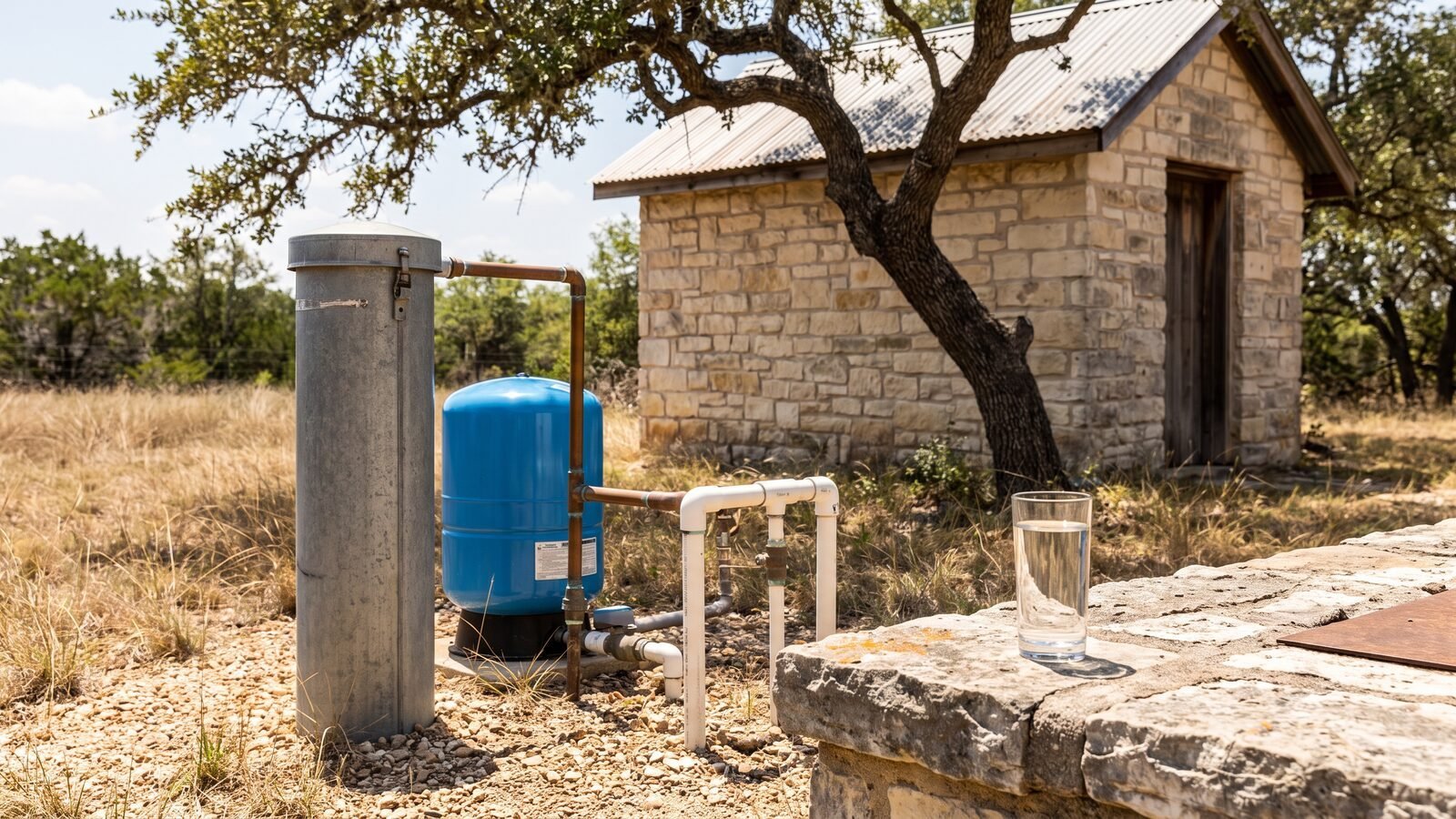
Walk out to your wellhead twice a year and look at it deliberately. Most contamination pathways are visible from standing next to it.
The casing should extend at least 12 inches above the ground and above any known flood level, with the ground sloping away from it so surface water cannot pool. A sanitary well cap should be sealed and vermin-proof, with a screened vent — a cracked or missing cap is an open invitation. Check for cracks in the casing and for any gap at the annular seal where the casing meets the ground.
Look at what is around it, too: livestock pens, fertilizer or fuel storage, a vehicle parking spot where fluids drip, and the septic drainfield. Texas construction standards require minimum separation distances between a well and an on-site sewage facility; if your well predates the neighboring system or the property has been subdivided, verify those distances rather than assuming them.
After any flood that submerges the wellhead, assume contamination. Test and shock-chlorinate before drinking. That is not a precaution, it is the expected outcome.
Pressure tank symptoms and what they mean
Your pressure tank exists so the pump does not start every time someone opens a tap. When it fails, it fails in ways people misread as pump problems, and a waterlogged tank will destroy a pump through short-cycling.
| Symptom | Likely cause | What to do |
|---|---|---|
| Pump cycles on and off rapidly during use | Waterlogged tank — the air bladder has failed | Have the tank checked or replaced; short-cycling kills pumps |
| Pressure surges then drops sharply at the tap | Bladder failure or wrong pre-charge pressure | Check pre-charge against the pressure switch setting |
| Sputtering air at the faucets | Water level dropped near the pump intake, or a casing leak | Call a licensed well contractor promptly |
| Sudden drop in overall flow | Failing pump, clogged screen, or declining water level | Do not keep running a pump that may be drawing air |
| Cloudy water that clears from the bottom of a glass | Air in the line — usually benign | Note it; investigate if it persists |
| Cloudy water that stays cloudy | Sediment or a genuine water quality change | Test before drinking |
How roof runoff and septic interact with your well
The reason a roofing company has an opinion here is that these systems are physically adjacent and nobody else looks at them together.
Roof runoff. Uncontrolled roof water concentrates surface flow. In karst terrain, water pooling near a wellhead or running into a fracture is a direct route to your aquifer. Gutters that discharge well away from the house — and away from the wellhead — are a groundwater protection measure as much as a foundation one.
Catchment systems. If you collect roof water for potable use, your roof is part of your water supply. That rules out lead flashing, tar-based patching materials, and galvanic pairs like copper against galvanized in the water path, and it requires a first-flush diverter to discard the initial dirty volume plus screening to keep organics out of the tank. Cistern overflow needs to be routed away from both the foundation and the wellhead.
Septic. On-site systems are permitted on projected daily flow and bedroom count, with required separation distances from wells. A remodel that adds bedrooms or bathrooms can require the system to be modified or re-permitted — and a failing or undersized system near your own wellhead is the most common source of the E. coli and nitrate results discussed above. This is exactly why we resolve septic and well conditions in discovery, before a remodel design is locked.
Frequently asked
Does anyone test my private well water in Texas?
No. Texas regulates well construction and plugging, but there is no ongoing water quality testing requirement for private wells and no agency monitoring them. If you do not test it, nobody does, and nobody will notify you if something changes.
My water tastes fine. Do I still need to test it?
Yes. The two most consequential contaminants — coliform/E. coli bacteria and nitrate — are completely undetectable by taste, smell, or appearance. Sensory changes are worth investigating immediately, but their absence proves nothing.
Should I test after a flood or heavy rain?
Always after a flood, and it is genuinely informative after any major rain event. Karst limestone lets surface water reach groundwater in hours to days with minimal filtration, so bacterial counts here can spike after rain in a way they would not in a sand aquifer.
Is hard water dangerous?
Not to your health. Calcium and magnesium at 15–25 grains per gallon are a maintenance problem: scale in water heaters, seized valve cartridges, fouled tankless exchangers, and permanent etching of glass and polished stone. Treat it for equipment life and finishes, not for safety.
How do I shock-chlorinate a well?
It involves calculating a dose for your casing volume, circulating it through every fixture, holding contact time, then flushing thoroughly and retesting. Done wrong it damages pumps and fixtures or gives you a false sense of security. For a first-time positive test, have a licensed well contractor do it and identify the pathway that let contamination in — chlorination without finding the cause just resets the clock.
This guide is general regional information for Hill Country property owners, not engineering, medical, legal, or insurance advice for your specific property. Figures cited reflect commonly published agency, manufacturer, and industry sources and vary by site. For foundation movement consult a licensed professional engineer; for water quality use an accredited laboratory; for wildfire mitigation see Texas A&M Forest Service guidance and your local fire authority.